Art Born of Cultural Blending: A Journey into the Mudéjar Style
- May 1
- 3 min read
We often read about cultures clashing and religions fighting to dominate a region, but what happens when people of different backgrounds are forced to live side by side? While textbooks tend to tell one version of history, an art form that emerged in medieval Spain reveals another.
Across the Roman Empire, there are countless examples of cultures blending, with local traditions woven together while still carrying something distinctly Roman. The Romans absorbed the nuances of each newly conquered region and combined them with their own aesthetic, allowing something entirely unique to emerge in each place.
This same kind of layering appears in language as well. Linguists can trace words and expressions within a dialect that reveal subtle histories of cultural contact and exchange.
The same is true of an artistic style that emerged in Spain known as Mudéjar.
Mudéjar refers to both a people and an artistic language. Historically, Spain was conquered in 710 by North African Muslims known as the Moors, who overtook the Christian Visigothic kingdoms. Beginning in 1021, Christian kingdoms initiated a long campaign to reclaim the peninsula, a process that lasted until 1492 with the fall of the Nasrid dynasty in Granada.
During this period, Muslims and Jews were eventually forced to convert to Christianity in order to remain, though Muslims were not formally expelled from Spain until 1609. This means that for centuries, amid constant shifts in power and deep internal conflict, Christians, Muslims, and Jews lived alongside one another.
By the 1100s, a new visual language had begun to take shape.
As a term describing a person, Mudéjar refers to Muslims who remained in Iberia after Christian reconquest. As an artistic style, it reflects the blending of Gothic, Renaissance, and Baroque forms with Islamic aesthetics, resulting in an architectural and decorative language that feels both restrained and richly expressive.
This style did not remain confined to Spain and Portugal. With Spanish expansion into Latin America, Mudéjar elements traveled and evolved further. In churches across the region, you can find these forms interwoven with Spanish Colonial architecture and Indigenous artistic traditions, all layered within a single structure.
Here is an excellent 5-minute video that introduces the Mudéjar ceiling style:
The Muslim artisans who remained in Spain during the 400-year Reconquest campaign, specialized in techniques involving brick, tile, wood, ceramics, and plaster. What makes the Mudéjar style so fascinating is that it is not quite Islamic, nor is it entirely Christian. It is a deliberate merging of the two dominant artistic languages that shaped medieval Spain and Portugal.
Travel region by region, country by country, and you will notice how local aesthetics filter through this already hybrid visual tradition.
In Aragón, the region in northern Spain most associated with Mudéjar, you will find soaring brick towers adorned with glazed tiles and cathedrals and palaces filled with intricate wooden lattice ceilings.
Here are some examples:

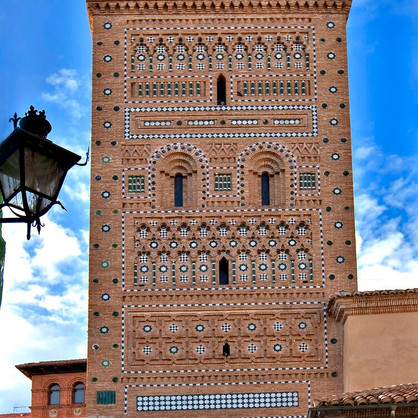


These brick and tile combinations show the meeting of Gothic and Islamic design, two styles coexisting seamlessly. Sources for Photo 1 and Photo 2.

The Aljafería Palace in Zaragoza, Spain, is another striking example of this layered heritage. Its geometric patterns reflect Islamic design, while the color palette, ornate floral scrolls, and inscriptions lining the halls speak to the Spanish Renaissance. Photo source.
You can also find Mudéjar synagogues, such as Santa María La Blanca in Toledo, Spain. Notice the arches, which resemble those in a mosque, paired with capitals that lean Gothic. This is an example of Muslim, Christian and Jewish styles all wrapped into one building.

You can read more about medieval synagogues in Spain by clicking here. Photo source.
As mentioned earlier, the Mudéjar style also made its way across the Atlantic. In the San Miguel Church in Sucre, Bolivia, you will see ceilings adorned with detailed geometric patterning, one of the hallmarks of Mudéjar design.


One of the most impressive examples in Portugal is the National Palace of Sintra, where tilework, carved plaster, and wooden ceilings intermingle with a rich Baroque atmosphere. Here's a photo below:

The Mudéjar style reminds me that beauty often emerges from moments of cultural convergence. These monuments are more than art and architecture. They are witnesses to the centuries of coexistence, conflict, creativity, and exchange. They are proof that art is rarely born from isolation but instead thrives where histories and cultures intersect. As a maker, I find there to be endless inspiration in this kind of blending.
Thanks so much for reading.
Take care for now,
Caitlin
For further reading:


Comments