When the Dress Speaks: A Portrait of Power & Symbolism
- May 21
- 4 min read
I have had this painting on my mind for years.
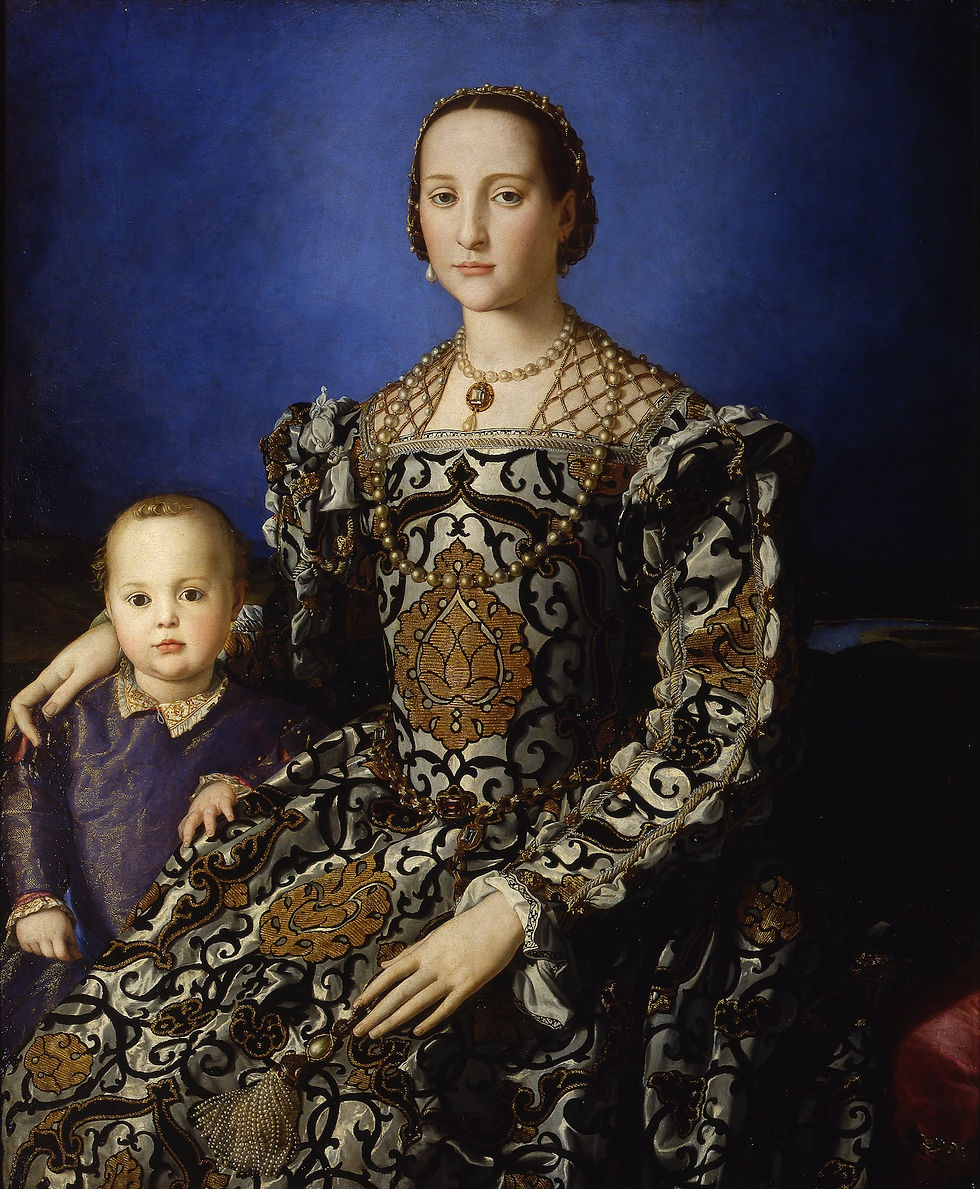
This portrait of Eleanor of Toledo by Agnolo Bronzino returns to me again and again and truly lives rent free in my mind. I have analyzed and studied every detail of it since I started my jewelry business in 2016. It first inspired my beadwork and later my metalwork. When I was studying wax carving in Florence, Italy, I visited the Uffizi Museum twice just to see it in person.
The striking blue background, the jewelry, and my goodness, that dress.
Let’s first talk briefly about Eleanor of Toledo, or as I prefer to write her name, Eleanora di Toledo.
Eleanora (b. 1522, d. 1562) was a Spanish noblewoman who married Cosimo de Medici. The Medici were a powerful Florentine family who founded the Medici Bank, though they originally had no noble blood. After a series of twists, turns, and family drama, Cosimo became the Duke of Florence and eventually the Grand Duke of Tuscany.
This generation of Medici needed legitimacy for their recent noble title and, more importantly, heirs.
Enter Eleanora. She was not only considered a beauty of her time, but she also came from noble lineage. She and Cosimo had eleven children together. It was Eleanora who helped firmly establish the Medici family and secure their power through a large line of heirs.
Now, back to the painting.
This portrait was commissioned as a state portrait. It was meant to portray the ideal Florentine woman in her finest clothing, shown alongside her second son as proof that she could produce multiple male heirs. While I generally find the role of women during the Italian Renaissance to be deeply problematic, this portrait uses symbols, motifs, and color to communicate power in ways I find fascinating.
The Color Blue
Blue was the most expensive color during the Renaissance. The pigment was made from crushed lapis lazuli and imported from the Middle East, primarily Afghanistan, where the stone is still mined today. Because of its cost and rarity, it was reserved for the most important figures in a painting, most often the robes of the Virgin Mary.
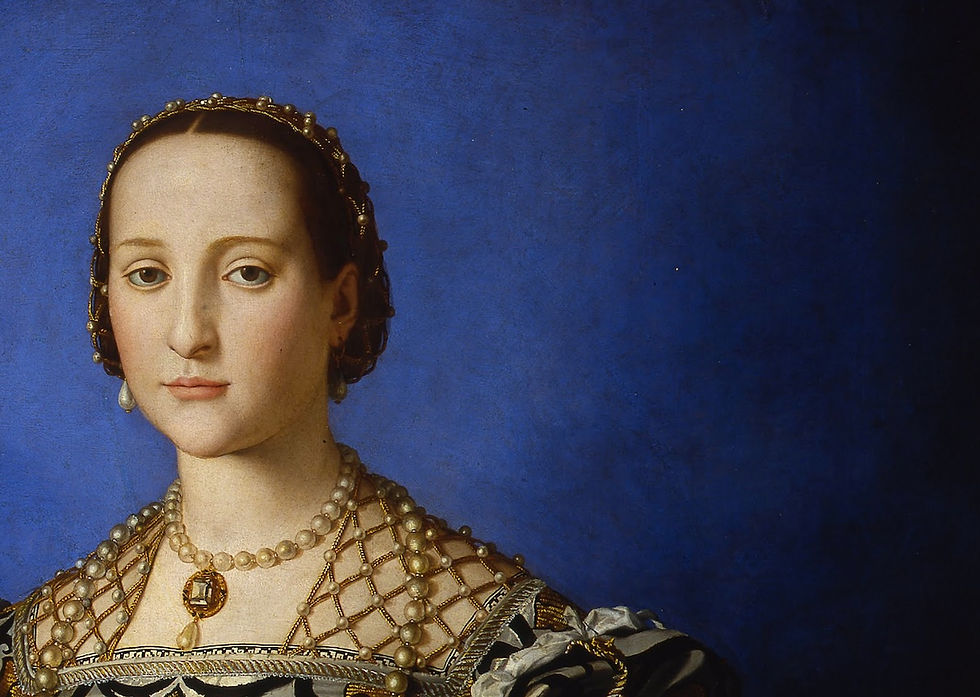
To paint the background entirely in this rich lapis lazuli blue conveyed several messages. Cosimo was displaying his wealth and power, but he was also positioning his wife and child to resemble the Madonna and Child. This visual association portrayed Eleanora as both powerful and wealthy, as well as pious and pure. Bronzino even painted a slightly lighter blue around her figure, creating a subtle halo effect.
The Pearls
Pearls symbolize purity and femininity, and they were said to be a favorite of Eleanora. In this portrait, she wears pearl earrings and two pearl necklaces, one adorned with a large diamond pendant. The diamond was a symbol of Medici strength.
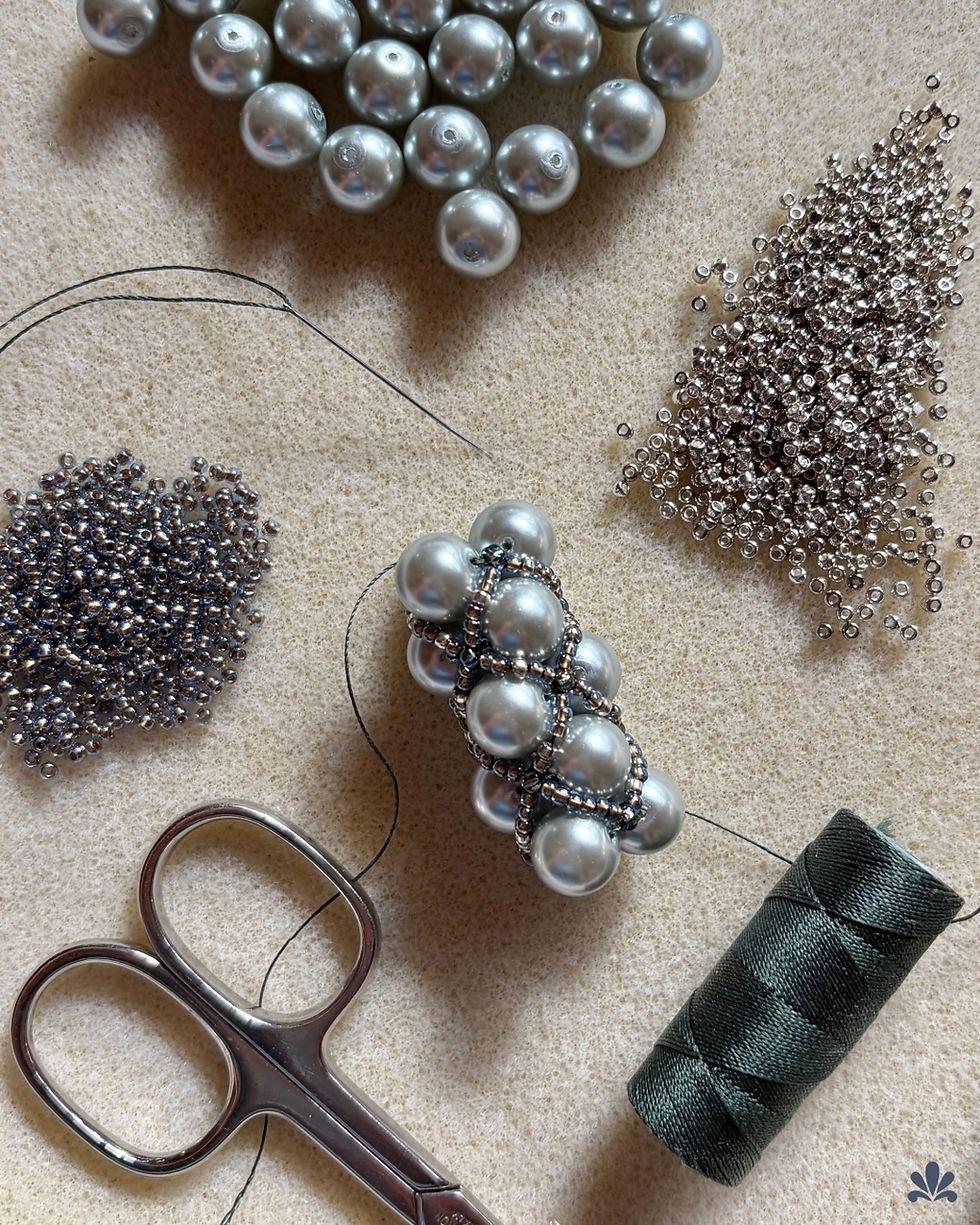
Her dress and hairnet are woven from gold chains and studded with pearls. This detail has inspired many of my own pieces, especially my beadwork. As I researched this painting more deeply, I created a necklace featuring a freshwater pearl and beaded a collar with glass pearls meant to echo the woven sections of her dress.

The Dress
There are multiple theories surrounding this dress, but for the sake of this blog, I’m choosing a version I’ve encountered repeatedly across several sources. Some details may eventually be revised by scholars, but as an artist and jeweler, I’m drawn to the stories behind it.
The brocade textile is the true star of the painting. Brocade is woven with colorful threads to create highly decorative and luxurious fabric, and in some cases, gold or silver threads were used. At the center of Eleanora’s dress is a golden pomegranate motif. The fabric itself would have been made of fine silk woven with real gold threads, symbols of wealth woven directly into the garment.
The pomegranate carries layered meaning. In Christian symbolism, it represents fertility. Its many seeds symbolized a woman capable of bearing many children.
The pomegranate was also significant in Spain. The Moors, who once ruled much of the region, introduced fruits from across their empire, including the pomegranate. Granada, home to the former Moorish Alhambra Palace, takes its name from this fruit. After the Catholic monarchs reconquered Spain in 1492, the pomegranate was absorbed into the Spanish flag and became a lasting national symbol.

Conclusion
I am drawn to this painting because it embodies my love for history and for objects layered with meaning and culture. It is a theme I return to often in this blog and one that continually finds its way into my work. With this portrait, the technical mastery enhances its beauty, but it is the symbolism and accumulated layers of meaning that give it its power and lasting presence.
I return to this painting again and again as a source of inspiration. Each time I revisit it, whether through research or observation, I uncover something new. With every detail revealed, my appreciation deepens, reminding me why objects rich with history and intention continue to shape the way I create.
Thanks so much for reading.
Take care for now,
Caitlin
Further Reading:


Comments